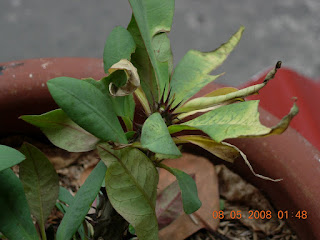
My first few attempts were in vain though. The plants died after three months much to my disappointment. How ignorant I was back then! I didn’t even asks my co-teachers how many times a week should I water it and where should it be placed. Few weeks have passed and this is now what my plant looks.
This is now my second attempt to propagate a euphorbia plant. Just in time for my plant dissection handbook, I will be able to use it as well during my dissections. Now I have a lot of questions in mind to ask the seller of euphorbia plants in our weekly “tiange”.
1. What is the breed of this euphorbia plant? Its imported she said… 2. Every when should I water it? Every week she answered… 3. Do I need to apply fertilizers on it? Yes, monthly would do. Do not overdo it… 4. Where should I place my plant? Near well lighted places. 5. Can I took it out of the soil then bring it back after my examination? Yes but do not water it right away. Wait for 2 days after then water it. 6. Why? So that the plant can adopt to a new soil and it would not drowned. 7. How much is it? Only 25 pesos. Different varieties are more expensive because of the petals. 8. Can I propagate it? Yes, one tip from me, choose the plants which has plenty of stems. You can cut these off later and plant, thus increasing your collection.
Isn’t it great? Now I’m caught in the euphorbia fever too!
Few months ago, I noticed some of my cp-teachers which are plant lovers are requiring drop-to-be students to bring euphorbia plants to our school as their project. Yeah it’s a laughing stuff at school normally students wouldn’t buy teachers’ wants. They thought it was a joke bringing plants to save their failing grades but my co-teachers were not joking! They really badly wanted to propagate this plant to their gardens. As soon as I am aware of this, that’s the time I noticed most of the front yards are starting to change their old plants to euphorbia. Until I realized euphorbia paint the town of Lumban red and pink.
So for my plant specialization, I chose this because of its abundance to my locality. I bought my first plant last March 2008. Brightly and bloody colored red flowers and heaps of green leaves there is. Then school days start and I forgot to take good care of the plants. As soon as this come to my attention, flowers begins to fall one at a time. I thought the plant were just adjusting to its new environment.
One time I got the chance to look at it closer. As I am getting close I noticed leaves were also diminishing! Mostly were already decaying on the soil and some had jagged margins. I tried to look underneath the leaves and to my surprise two caterpillars are devouring my plants! I hurriedly pick a stick and took it out of my sight. Well too late, leaves are badly damaged and stems were all left out. I pull out the complete fertilizers I bought together with the euphorbia then I observe it after a few days later. These are some of the pictures I took for my documentation.
this photo was taken after i took my euphorbia plant away from the garder in front of our yard because i thought caterpillars that ate my plant were from the other plants. i placed my euphorbia plant in front of my window next to where i could always observe it. i also apply fertilizers to it and water it every after two days.
I bought my euphorbia plant last February 2008 for the flower pots in front of our house. I chose this kind of plant because summer days are coming and I have learned from my co-teachers that these relatives of cactus grows best in sunny and dry places. Another thing that I consider in buying euphorbia is its low maintenance characteristics. It doesn’t require full attention and even watering is not on regular basis. Another is because it is always in full bloom most of the time.
Upon choosing the euphorbia I pick the ones with bright red color-flowers. It’s like red roses from a far. The flowers are very attractive and the plants look healthy. The sales man said it is a hybrid. I also bought 2 packs of complete fertilizers. The gardener said it would also help improve the flowering of my plant.
here is a short background information about my plant specialization:
Crown of Thorns
Scientific Name:Euphorbia milii var. splendens Des Moul.
The family Euphorbiaceae is large with about 8,100 species found throughout the world, excepting the Arctic region. Euphorbia itself is a very large genus with over 2000 species. They are characterised by having a milky latex which can cause burns and indeed some may be carcinogenic. The xerophytic species most often have spines and our plant this month - Euphorbia milii var splendens - is no exception. Surprisingly, since it does not need too much watering and, especially the fact that it flowers most of the year, but particularly in the winter months, it has become a cherished house plant for sunny dry situations.
Euphorbia milii var splendens, commonly called Crown of Thorns, is a straggly, spiny shrub bearing bright red bracts and, given a chance, will grow to 2m. Euphorbia milii was named by Des Moulins in 1826 and, while not a succulent, can withstand long dry periods when the plants will shed their leaves. The stems are furrowed and furnished with stout, tapering spines about 2cm long. The leaves occur at the top of the shoots and the branched inflorescences grow from the leaf axils. The variety splendens is simply a larger form than the species itself and occurs naturally. In fact there is considerable variation in the wild in south-west Madagascar and several have been named, including a yellow flowered form, also grown for the pot plant industry.
Of course, the related Poinsettia - Euphorbia pulcherrima - from Mexico, is a major player in the Christmas pot plant industry. These will be on sale from the Friends in December.
Many of the African species of Euphorbia have developed in parallel evolution with the Cactaceae of the Americas. This can be seen in the two borders of the Xerophytic (Succulent) House. (The information board explains the details.) Euphorbia milii var splendens has been pot grown at the Garden for many decades and was planted in the African border when the glasshouse was redesigned about 20 years ago.
Cultivation. Euphorbia milii var splendens demands a bright, sunny situation and, while it can withstand temperatures as low as 45'F (7.5'C), it is best not to let the temperature fall below 50'F (10'C). A well drained compost is essential, for the roots will not tolerate soggy conditions. In fact the plants are better kept drier in the winter time.
Propagation. Summer cuttings of the current years growth taken about May or June will root in heat. When taking the cuttings it is best to dip the cut ends in charcoal to stop the latex flow before inserting into a sandy compost.
Position. Euphorbia milii var splendens is growing in the Xerophytic House on the right at the entrance from the Corridor.
Sadness fills my empty space as i glare through his heart's summons.
Longing to ease his agony somehow.
I drenched with him in midnight rain. Perilous love puts everything in jeopardy.
I crave to witness the sun shines back at him.
Exorbitant friendship is all I could offer.
Hoping this would tranquil his wounded heart... For my buddy, whose heart is at apathy of sheer love.
*** Never loose your grip with love for it will find you no matter what. If your heart is nowhere to be found just wait until time let it flies back into you.
*** Monotony of life builds unbalanced being. It entomb one's self in lampoon of hapiness. Friends cease to ease this shanty of isolation. I thank you for taking this part.
*** Choosing chances are only limited to those who conceived of loosing. Never quit in life for it must go on no matter how hard it is. May you have more sucess in life.
*** As i track my way to school. Tracing those paths that once we've taken. Leaving my nest for i have to strugle for life. Until this afternoon we'll cross our paths once more.
*** Memories are engravings of a heart made of gold. For we are the artist that effluence shinning smiles. Every rivulet of happy moments spurt out into an ocean of treasures. May this day carved another impressions on gleaming heart.
*** I may not at your side at times of sadness. I may not right there to wipe away those tears but one thing i can assure you... Every heart aches you keep inside crashes me from within, every tears falling down from your face drowns me tremendously, every agony and pain you feel devours me slowly as well.
*** An empty heart is what he is... Strugling to find a relationship that's true. Like an ocean of scapes with an endless path. Compass his heart to break the hiatus of scarce. He's a scavenger of love, life and friendship. Take every chances of it and cherish them all.
Bata p ako nung mamatay si tatay mga grade 3 sa pagkakantanda ko at malaki pagkawala nya sa aming pamilya..
Sa musmos kong pag akap sa aming kalagayan nagkaroon ako ng takot para sa aking nanay.. Tila ginulat ako sa katotohanang maari itong mangyari sa kanya o sa kahit na sinong aking mahal sa buhay..
Ayaw kong aminin sa sarili kong mangyayari ito pwedeng ngayon, pwedeng bukas o pwedeng sa susunod na panahon pero sa aking pagkukubli sa isip ay lumalabas naman sa aking kilos at gawa..
Tuwing gabi sinasadya kong di agad matulog at bagkus ay hihintayin ko munang mauna matulog ang aking nanay.. Sa kanyang pagkakahiga at mahimbing na pagkakatulog ay dahan dahan kong lalapitan at tititigan ang kanyang dibdib..
Tanong ko pa sa sarili ko noon kung humihinga ba siya? Tumataas baba ba ang kanyang dibdib senyales na siya ay maayos n humihinga? Di pa ako makukuntento at dahan dahan akong lalapit at itatapat ang aking darili sa kanyang ilong upang maramdaman ang hangin n lumalabas pasok sa kanyang baga.. Tinangka ko pang pakinggan ang pagtibok ng kanyang puso ngunit bigo akong magawa ito sapagkat natatakot akong magising si nanay.. Di ko alam ang isasagot ko kung sakaling mahuli nya ako sa ginagawa ko..
Kasabay noon ang aking pagtitig ng mariin sa itsura ng aking ina at tila kinukumbinsi kong masigla at buhay n buhay ang aking nanay sa mga sandaling iyon.. Ilang minuto ko ito ginagawa gabi gabi bago matulog noong bata pa ako.. Tila pilit kong kumbinsihin ang sarili kong di n pwede maulit ang nangyari sa aking tatay at sa murang edad ko ay iyon na ang tanging paraan kong magagawa upang masiguradong di na maaring mangyari uli ang katotohanang tumatakot sa akin..
Simula noon namulat n ako sa katotohanang ang buhay ay mayroong hanganan.. Binuksan nito ang aking murang isip sa reyalidad na walang kasiguraduhan ang bukas at ang mga susunod na araw.. Nabatid kong mas mahalaga ang kasalukuyan kumpara s hinaharap at mas dapat kong pahalagahan ang pagkakataong ngayon na aking tinatamasa..
Sa murang isipan kong iyon lahat bumungad sa aking ang mga karanasang pilit magpahinog sa aking katauhan at gayundin kung paano ko tingnan ang buhay..
Sa pagkakataong ito ay nakaharap muli ako sa aking nanay.. Tila bumalik ako sa aking pagkabata at parang musmos n nakatitig sa kanyang pagkakahiga sa kama ng hospital.. Bumabalik ang multo ng aking nakaraan.. Muli kong kinukumbinsi ang sarili kong may magagawa na ako.. Di na ako tulad ng dating napakamurang edad at halos walang magawa kundi ang tumitig at magbantay sa pagkakahimbing na tulog ng aking nanay..
Siguro nga ngayon ay mas matapang na ako at mas siguradong kayang harapin ang hinaharap.. Nagbago na nga ako ngayon pero isa parin ang katotohanang di ko malulusutan.. Ito ay ang reyalidad na hindi nagbabago ang panahon.. Ang aral ng kahapon ay buhay na buhay at nagbabanta sa akin..
Ginigising ako ng aking ulirat na maaring di pa huli ang lahat.. Mayroon pa akong magagawa sa upang iliko ang hamon ng buhay.. Nanlalamig ang aking talampakan at parang magpapawis ang aking kamay.. Kilos! Kabog ng aking dibdib.. Kilos! Sigaw ng aking isip.. Kilos! utos ng aking katawan..Nagkakasundo ang tatlong bulong sa aking kalooban.. Kailangan ko nang kumilos at gumawa ng paraan.. Hindi simpleng pagkakataong lamang ito na mapunta sa hospital ang aking nanay.. Ito ay isang maagang pagbabadya ng maaring kaharapin ko balang araw..
Yayakapin ko na ang hamon ng kasalukuyan... paghahandaan ko na ang banta ng hinaharap.. Marahil totoong walang kasiguraduhan ang bukas ngunit kaya ko pa itong baluktutin at iligaw..
One day while preparing some PowerPoint slides about embryonic development for my students I stumbled into one of those site where it explains that pictures I was very familiar with based on the books I have were all hoax!? I was surprised and realized I was somewhat misleading my students on the topic of evolution and embryonic development.
Well just like Lamark’s theory of evolution, we couldn’t change the fact that some “hypotheses” exists just to give notion that there may be some good points and also to give us point of comparison between the other theories such as Darwin.
On this matter, generations of biology students including me, may have been misled by a famous set of drawings of embryos published 123 years ago by the German biologist Ernst Haeckel. They show vertebrate embryos of different animals passing through identical stages of development. But the impression they give, that the embryos are exactly alike, is wrong, says Michael Richardson, an embryologist at St. George's Hospital Medical School in London. He hopes once and for all to discredit Haeckel's work, first found to be flawed more than a century ago.
On the brighter side, it’s always to know a thing which is out of the ordinary books. Our reference materials may not be sufficient enough for these but it’s important that we gather information from different sources and not sticking out on things that our eyes could only see.
Here’s the article:
HAECKEL AND THE VERTEBRATE ARCHETYPE
A recent paper by Michael Richardson and his colleagues (1997) has corrected a major misunderstanding among developmental biologists and evolutionary biologists which can be traced back to Ernst Haeckel. Haeckel (1874) had claimed that members of all vertebrate classes pass through an identical evolutionarily conserved "phylotypic" stage. Until this new paper appeared, it was assumed that Haeckel was correct and that there was a particular stage of development that was identical to all vertebrates. Only later in development would specific differences appear. Interestingly, there was some discussion as to what exactly this stage was (Richardson , 1995). This conserved stage was sometimes considered the neurula stage (Wolpert, 1991), the "pharyngula" stage (characterized by the branchial arches; Ballard, 1981), the tailbud stage (Slack et al., 1993), or the stages between those of headfold and tailbud (Duboule, 1994). Figure 1 shows one of Haeckel's representation of vertebrate embryology. The top row shows that all the vertebrate embryos (no matter what path they took to reach this stage) have a stage where they appear almost identical.
FIGURE 1. Haeckel's 1874 version of vertebrate embryonic development. The top row shows an early stage common to all groups, the second row shows a middle stage of development, and the bottom row shows a late stage embryo. Groups from left to right are: fish, salamander, turtle, chicken, pig, cow, rabbit, and human. (Adapted from Gilbert, 1997.)
But Haeckel's drawings are wrong. Photographing actual embryos at these stages, Richardson and colleagues show that Haeckel's drawings are oversimplified to the point of obscuring important differences between classes of vertebrates. The Richardson et al. paper does not dispute that there is a highly conserved embryonic stage among the vertebrate classes. Indeed, at the late tailbud stage, vertebrate embryos of most all classes possess "somites, neural tube, optic anlagen, notochord, and pharyngeal pouches." However, these authors do criticise the notion that this stage is nearly identical in all species and that differences beteen the classes can be resolved only after subsequent development. Rather, they discover significant differences between groups. Size is one distinctive marker. The scorpion fish embryo is 700 microns long at the tailbud stage, while the mudpuppy salamander measures some 9 millimeters. Heterochrony is another problem. In some species of direct developing frogs, and in monotreme mammals, limb buds are already present at the tailbud stage, whereas in other species, these are not seen until significantly later. Birds are characterized by their prominent mesencephalon. Whereas most amniote embryos have a heart by this stage, the zebrafish does not. (Teleosts such as zebrafish are even the exception to the rule mentioned above. They eventually possess a notochord, somites, pharyngeal pouches, etc., but they do not have the pharyngeal pouches until after the tailbud stage). Some of these differences are depicted in Figures 2 and 3.
FIGURE 2. Selected embryos shown at the "phylotypic" stage. (A) Sea lamprey (jawless cyclostome fish, Petroyzon) with nearly identical pharyngeal pouches and heart that is caudal to the pharynx; (B) electric ray (cartilagenous chondrichthes fish, Torpedo) with nearly identical pharyngeal pouches and a pronounced hindbrain/midbrain flexure; (C) sterlet (bony Osteichthyes fish, Acipenser) where the pharyngeal pouches have not yet formed; (D) frog (direct -developing anuran amphibian Eleutherodactylus) which has hindlimb buds at the tailbud stage and only two pairs of aortic arches; (E) pond turtle (chelonian reptile, Emys) where there is no craniocaudal rotation (torsion) to the embryo, whereas the same stage of the chick (avian) embryo (F) shows pronounced torsion; (G) brush-tailed possum (marsupial mammal, Trichosurus) where there is (in contrast to the cartilagenous fishes) large maxillary and mandibular processes. In ther cat (eutherian mammal, Felis) there is a similar size difference between the anterior and posterior pouches, although their appearance differs from that of the marsupials. (After Richardson, 1997.)
FIGURE 3. Photographs of a fish, amphibian, reptile, mammal, and bird embryo at the "phylotypic" stage. Photographs courtesy of M. Richardson.
Interestingly, this knowledge appears to be "old hat" among German biologists. Haeckel's drawings were not trusted (see Goldschmidt, 1956), and Haeckel was accused of scientific fraud by a university court in Jena, where he worked and by other embryologists, as well (see Hamblin, 1997; Richardson et al., 1997b). Yet, the idea that early vertebrate embryos are essentially identical has survived. I think there were two reasons for the survival. First, Haeckels' illustration was reproduced in Romanes' (1901) Darwin and After Darwin. From here, the illustration entered Anglophone biology, "sanitized" from Haeckel. Second, the picture can be used (as it has been in several developmental biology books, including my own [Gilbert, 1997, p. 254]) to illustrate von Baer's principles rather than Haeckel's biogenetic law. K. E. von Baer had noted that the general features of a large group of animals appear earlier in the embryo than do the specialized features. Indeed, von Baer wrote:
"The embryo of the mammal, bird, lizard, and snake and probably also the turtle, are in their early stages so uncommonly similar to one another that one can distinguish them only according to their size. I posess two small embryos in spirits of wine, embryos whose name I neglected to note down, and I am now in no position to determine the classes to which they belong. They could be lizards, small birds, or even very young mammals."
Darwin quoted this (it was Thomas Huxley's translation) although he misattributed the story to Agassiz rather than to von Baer (see Richards, 1992 for an analysis). The notion of development proposed by von Baer is still used as a general approximation of certain developmental phenomena. Certainly, the early embryos of certain vertebrate classes are very similar (for instance, the chick and mouse twenty-somite embryos), and the processes of somitogenesis, limb formation, axis generation, etc. are probably conserved throughout the vertebrate groups).
Similarities and differences
What the Richardson et al. paper tells us is that we have to be attentive to the differences as well as to the similarities. A bird embryo is not the same as a mammalian embryo. We should not assume identity, even at a stage where all vertebrate embryos seem to pass. The Richardson et al. paper can be read as a critique of the recent priority of similarities over differences.
The concept of homology enables one to celebrate the differences or the similarities between two structures. Whether one emphasizes the similarities between our forelimb and a bird's wing or the differences between them depends on what you are describing. Comparative anatomy--with its Aristotelian and Cuverian interest in relating structure to function--usually emphasizes the differences. Morphology--with its Platonic and Geoffroyan interest in the underlying unities of structure--usually focuses on the similarities.
As Joseph Needham noted, embryology has swung between these two poles during different stages of its morphogenesis. In the late 1800s, the morphological tradition prevailed, and the similarities between developmental stages in different organisms constituted some of the best evidence for classification (see Nyhart, 1995; Bowler, 1996). Thus, the discovery of the Nauplius stage of the barnacle showed that it was a modified crustacean, and the notochord-containing tadpole of the tunicate demonstrated its affinities with the chordates. However, after the 1920s, embryology was no longer a major support for evolutionary biology, and the comparative anatomy tradition came to predominate. Until the 1980s, embryology was extremely descriptive. Each organ was seen to develop differently from any other organ, and each species was seen to develop differently from any other species. Indeed, embryology was defined (by one of its practitioners, E. G. Conklin) as a "lawless science" because generalities could not be made from the observations of animal development. When embryology underwent its anagenic transition to become developmental biology, the similarities among organisms were again emphasized. The similarities were now posited on the molecular rather than the morphological or cell lineage level. The 1990s has seen a remarkable celebration of the similarity of molecular processes throughout the animal kingdom. Homologous genes abound (the Hox genes, fringe , tinman, and Pax6 being seen to specify the anterior-posterior axis, the limb, the heart, and the eye, respectively, of organisms as diverse as insects and flies). Even signalling pathways are seen as being homologous both within a developing organism and between organisms. Thus, the neural tube in vertebrates and insects are seen as being formed through the same interactions of the "same" proteins, even though one neural tube is dorsal and the other ventral. The Richardson et al paper reminds us that despite these similarities, differences are also important, especially if one is thinking in terms of the relationships between development and evolution.
The Richardson et al paper is a also plea for comparative anatomy and less reliance on "model systems." This critique of model systems echoes a recent plea from Leo Buss, Rudy Raff, Jessica Bolker, and James Hanken who observe that model systems converge on several factors (see Bolker and Raff, 1997; Hanken, 1993): they all can develop in the laboratory and are thus relatively free of environmental factors effecting their morphogenesis; they are all organisms which segregate their germ line extremely early; they develop rapidly, are small as adults, and they have short generation times.
The Richardson et al. paper does a great service to developmental biology. As they mention, there is renewed interest in evolutionary developmental biology, and in view of the conservation of developmental mechanisms, we need to re-examine the extent of variation in vertebrate embryos. There is more variation than had been assumed, and these variations foreshadow important differences in the adult bodies. This is important because we need to know how conservative the early embryonic stages actually are.
References:
Ballard, W. B. 1981. Morphogenetic movements and fate maps of vertebrates. Amer. Zool. 21: 391 - 399.
Bolker, J. A. and Raff, R. A. 1997. J. N. I. H. Res. 9: 35 - 39.
Bowler, P. J. 1996. Life's Splendid Drama. U. of Chicago Press, Chicago.
Duboule. D. 1994. Temporal colinearity and the phylogenetic progression: a basis for the stability of the vertebrate Bauplan and the evolution of morphologies through heterochrony. Development (suppl.) 1994: 135 - 142.
Gilbert, S. F. 1997. Developmental Biology. Fifth ed. Sinauer Associates, Sunderland, MA.
Gould, S. J. 1977. Ontogeny and Phylogeny. Belknap Press, Cambridge, MA
Haeckel, E. 1874. Anthropogenie oder Entwickelungsgeschichte des Menschen. Engelmann, Leipzig.
Hambin, T. J. 1997. Haeckel's drawings. Times (London), 18 Aug. 1997.
Hanken, J. 1993. Model systems versus outgroups: alternative approaches to the study of head development and evolution. Amer. Zool. 33: 448 - 456.
Nyhart, L K. 1995. Biology takes Form: Animal Morphology and the German Universities 1800-1900. University of Chicago Press, Chicago.
Richards, R. J. 1992.The Meaning of Evolution. U. of Chicago Press, Chicago.
Richardson, M. K. 1995. Heterochrony and the phylotypic period. Dev. Biol. 172: 412 - 421.
Richardson, M. K., Hanken, J., Gooneratne, M. J. Pieau, C., Raynaud, A., Selwood, L., and Wright, G. M. 1997. There is no highly conserved embryonic stage in the vertebrates: implications for current theories of evolution and development. Anat.Embryol. 196: 91 - 106.
Richardson, M. K., Hanken, J., Selwood, L., Wright, G. M., Richards, R. J., Pieau, C., and Raynaud, A. 1997b) Haeckel, embryos, and evolution. Science 280: 983 -984.
Romanes, G. J. 1901. Darwin and After Darwin. Open Court, london.
Slack, J. M. W., Holland, P. W. H., and Graham, C. F. 1993. The zootype and the phylotypic stage. Nature 361: 490 - 492.
Wolpert, L. 1991. The Triumph of the Embryo. Oxford University Press, Oxford.
this is your chance to become an experienced biologist! for this semestral break we are on the field. i will require you to have your very own plant dissection handbook which will be submitted when you get back to school this november 3.
as we study morphology this second grading period, i will require you to apply all your knowledge about plants. decide what plant you wanted to become an expert with. list down all the questions you have in mind and as we go through the discovery process i hope this would get sparks in your mind. never be afarid to try out something different and something new. be at your own pace of learning, plan out when and where you will want to dissect your plant. express your creativity and resourcefulness for your personalized handbook.
experiment this out with your friends and other family members! enjoy learning and have fun unlocking some mysteries around you! you may even be delighted discovering new knowledge you thought the other way around.
BTW (by the way) i have uploaded my plant and animal dissection handbook only as your guide. still i want you to express your own individuality and originality. any questions or clarifications? leave me a message on the chat box or send me an email. i will be more than happy to help you out. Good luck everyone!
My pamangkin assistant examining the flower pattern
Here’s a little botany for those who care about such things. The brightly coloured ‘petals’ on poinsettias and their Euphorbia relatives are actually modified leaves called ‘bracts.’ The flowers are in the centre, quite small and uninteresting looking. Please see my dissection handbook for a closer view. thanks
Communication between Dogs- Interrelationships Exact methods of communication between dogs have long since been a mystery. For example: properly socialized dogs meeting for the first time can soundlessly evaluate each other in a short time. They can do this through an exchange of glances which will also decide if they will be friends or enemies. Dogs do this without any sophistiated verbal language. Dogs use various body parts to communicate with each other: various postures, and facial expressions. In most cases facial expressions and body language complement the impact of vocals (i.e. barks and growls). Odor also plays a signifiicant part in dogs' recogniton and interaction.
Body Language.
Dogs communicate Dominance by:
Humping. Looming Over. Urinating by lifting leg. Lifting Tail. Resting head on another dog's back. Placing paws on another's back
Dogs communicate Deferrence and Submission by: Urinating by Squatting. Rolling Over Tilting (or turning away) neck/head. Hanging head. Tucking in tail
Other gestures inlude:
Caution: Wagging tail (slowly) in horizontal motion. Fear: Tail is held low or tuked Content: Tail is relaxed (and stationary). Excitement: Randomly wagging tail . Threat: Tensing muscles and raising hackles Invitation to play: Head low with elevated rump.
Facial Expressions. Dogs exhibit different kinds of facial expressions. These expressions can be understood by other dogs of thesame and different species. To intimidate another, a dog would stare with it's eyes wide open, ears pointing forward, and teeth bared. A dog in a relaxed mood will have its eyes in a more relaxed mood ears relaxed (flopped), having an expression somewhat like a smile: mouth open, lips slightly back, and tongue hanging flabbily from the side of the mouth. In an anxious state, the dog would glance away and its ears may fall to the side of the head or may be flopped. While clenching its teeth, the dog's lips will be rigidly drawn back. Its tongue may or may not be exposed (depending on if it is lip-liking). If afraid , a dog would either stare forward or away with widely dilated pupils and ears pressed (back close to the head). The dog may also pant or breath hard (mouth may be slightly open or tightly closed); meanwhile, the sinews show in the cheeks through tensing of its jaws. They communicate their moods and intentions through combinations of these. Dogs' expressions may often appear undecided. It may be a mixture of completely different expressions.
Odor.
Odor communiation between dogs is fairly ambiguous. Dogs have an exquisitely powerful sense of smell. There is a likelihood that they learn about other dogs from smell. This may acount for their random sniffing habit. It is unclear what sort of information passes between dogs via this medium. It is well known however, that intact male dogs typically smell "male” (because of male sex pheromones) and that neutered males do not have this characteristic smell. The neutering process involves changing the olfactory signals the dog emits and therefore other dog's perception of it. It is possible that the "non-male" smell of neutered dogs may be thesame as that of the interval between heat periods (diestrus) or that of a neutered female dog. Odor causes differences in interactions between dogs. For example a meeting between an intact and a neutral male may not be confrontational because the intat dog does not pereive a rival- he may believe the nutered dog is female!